

You know that moment when you’re crushing your workout, feeling like an absolute champion… and then your bra decides to become a personal swamp ecosystem? Yeah, we need to talk about that.
Here’s the thing about regular cotton and basic synthetic bras: they’re basically moisture magnets that hold sweat hostage against your skin. We’re talking about fabrics that lack the capillary action and hydrophobic polymer treatments that make true sweat resistance possible.
Sweat-resistant bras use moisture-wicking technology to actually transport perspiration away from your body through a process called moisture vapor transmission. The real game changer comes down to understanding how these performance textiles work alongside your specific activity demands.
Why Regular Bras Stay Wet and Cause Chafing
Cotton acts like a tiny sponge strapped to your chest.
It absorbs sweat and stubbornly holds onto it.
That’s the opposite of what you need.
Here’s what happens when moisture retention takes over.
The fabric gets heavy.
It clings.
It creates warm, damp pockets under your breasts where bacteria throw a party.
The result? Itching, irritation, and those annoying breakouts nobody wants.
Wet fabric is also a friction nightmare.
Your straps dig deeper into your shoulders.
Rough seams scrape against skin that’s already softened by moisture.
That structured band? It’s now grinding against your ribcage with every breath.
Hydrophilic fibers in cotton blends love water a little too much.
They can take hours to dry, which means:
- Prolonged bacterial growth in high heat zones
- Increased mechanical friction at every contact point
- Raw spots forming where seams meet skin
Cotton retains moisture for around 45 minutes, creating the perfect environment for odor and skin irritation.
Sports bras with moisture wicking technology flip the script entirely.
They pull sweat away from your body and spread it across the fabric surface.
It evaporates fast.
You stay dry.
Antimicrobial treatments add extra protection against odor causing bacteria, and seamless construction eliminates those friction points that regular bras create.
How Sweat-Resistant Fabric Technology Works
Capillary action does the heavy lifting here.
It’s the same physics that makes paper towels work, just engineered into your clothes.
The inner layer uses hydrophilic fibers that actually love water.
They grab sweat right off your skin before you even notice it.
Think of them as tiny moisture magnets working overtime.
That perspiration then travels through microchannels to reach the outer layer.
This surface is hydrophobic, meaning it repels water and spreads moisture across a wider area.
More surface area equals faster evaporation.
Simple math, big results.
Sports bras take this further with strategic design choices:
- Polyester blends that dry quickly
- Mesh zones placed in high sweat areas
- Antimicrobial treatments that kill odor causing bacteria
Here’s the real win.
You won’t need to wash after every single workout.
The bacteria that make things smell? They’re handled before they become a problem.
The whole system pulls sweat away before it pools against your skin.
No sticky discomfort.
No visible wet spots during your gym selfie.
Just fabric that actually works as hard as you do.
Look for designs with unpadded mesh construction and ventilation zones that maximize airflow while pulling dampness away from the skin.
5 Performance Benefits of Sweat-Resistant Bras
Moisture-wicking fabric pulls sweat away from skin before it pools.
That’s the real game changer during intense cardio.
Standard cotton holds 7% of its weight in water and turns into a soggy mess.
Performance fabrics? They move moisture to the outer layer where it evaporates fast.
Here’s why your workouts actually feel different:
- Less chafing: Dry skin means seams glide instead of grinding. Your 10K just got a lot less painful.
- Odor control: Antimicrobial treatments like silver ion technology attack bacteria before the funk starts. You can rewear between washes without clearing the room.
- Temperature regulation: Quick dry fabrics prevent that lovely post workout chill where you’re standing in a wet sports bra wondering why you thought this was fun.
- Consistent compression: Wet fabric stretches and sags. Hydrophobic materials maintain their elasticity, so bounce control stays locked in through burpees, box jumps, and everything else you throw at it.
You know that mid workout moment when you’re tugging and adjusting instead of focusing?
These technical upgrades eliminate it.
Your energy goes toward your goals, not your gear.
By keeping the under-breast area dry, you avoid the skin-on-skin rubbing that leads to irritation and rashes in the first place.
How to Choose the Right Sweat-Resistant Bra
Buying the wrong size defeats the purpose of fancy fabrics. Let’s fix that.
Support level needs to match your activity. This isn’t optional.
Low support works for yoga and stretching.
Medium handles cycling and weight training.
High impact is non-negotiable for running, HIIT, or anything with jumping.
Fabric matters more than you’d think.
Look for polyester-spandex blends that pull moisture away from skin fast.
Cotton holds sweat like a sponge.
You don’t want that.
Fit check time:
- Band should feel snug with room for two fingers underneath
- Cups need zero spillage on top and no gaping at the sides
- Straps stay put without digging trenches into your shoulders
Ventilation panels and seamless construction prevent chafing when workouts stretch past the hour mark.
Your skin will thank you later.
Anti-odor treatments are clutch for back-to-back gym days.
Nobody needs to announce their workout schedule through scent alone.
Here’s where people mess up: care instructions.
Cold wash and air dry keep spandex stretchy and wicking power intact.
The dryer murders performance fabrics.
Just hang them up.
The band should lift your breast slightly off your chest to keep the underboob fold from sealing shut and trapping moisture.
How to Wash and Care for Sweat-Resistant Bras
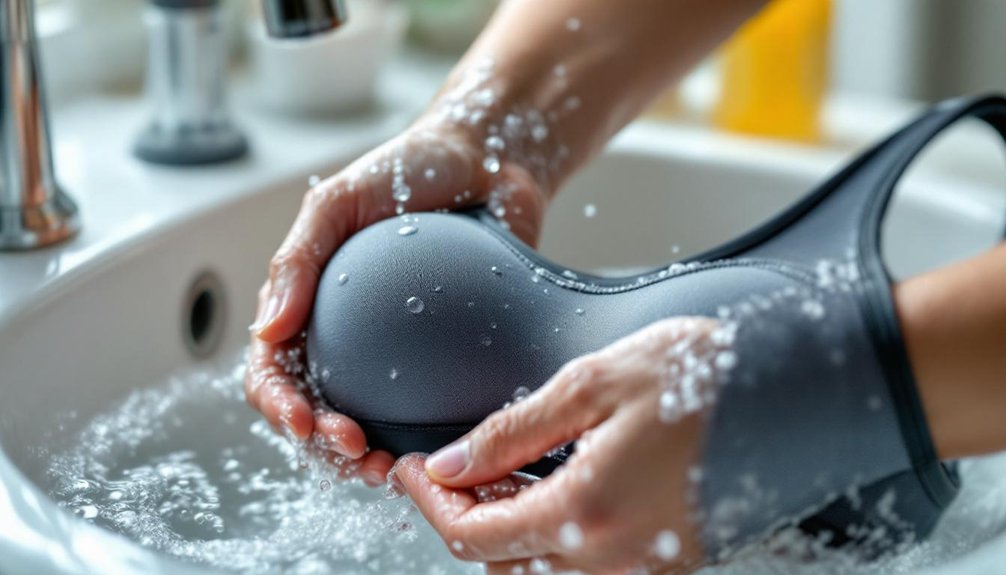
Your fancy moisture-wicking fabric doesn’t care how much you paid for it.
Toss it in a hot wash with your jeans, and those antimicrobial finishes will wave goodbye faster than your motivation on leg day.
Cool water is your best friend here.
We’re talking 30°C or less.
Heat destroys elastic and strips away the technical coatings that keep you dry and stink-free.
Washing basics:
- Wash every 2 to 3 wears, not after every single session
- Use mild, fragrance-free detergent only
- Skip fabric softener completely, it coats fibers and kills wicking performance
- Fasten all hooks before washing
- Use a mesh laundry bag on gentle cycle, or just hand wash
Drying rules:
- Air dry flat or hang by the band
- Keep it in the shade
Never, ever tumble dry.
That dryer heat breaks down spandex fibers and warps molded cups.
You’ll go from supportive to saggy in just a few cycles.
Store your bras flat on a shelf.
Folding one cup into the other stretches the foam and distorts the shape over time.
Yes, it takes up more drawer space.
Your bras will thank you by actually lasting.
Frequently Asked Questions
What Is the 3 Bra Rule?
The 3 bra rule means rotating three bras daily, giving each 48 hours rest between wears. This rotation extends elastic longevity, maintains underwire shape, and reduces washing frequency. Lingerie experts recommend this system to preserve fabric integrity and ensure proper fit retention for approximately six to nine months per bra.
Why Do Soccer Players Wear Bras During Games?
Soccer players wear GPS tracker vests, not bras, to monitor performance metrics like heart rate, distance covered, and sprint speed. Companies like Catapult Sports and STATSports manufacture these devices, which collect real-time data helping coaches optimize training loads and reduce injury risk during matches and practice sessions.
What Is the 2 Finger Rule for Bras?
The two-finger rule is a quick bra fitting technique where you slide two fingers under the back band. If they fit snugly without gaps or tightness, your band size is correct. Proper band fit ensures 80% of breast support comes from the band, not the straps.
Can Sleeping in a Sports Bra Keep Your Breasts Perky?
No, sleeping in a sports bra won’t prevent breast sagging. Cooper’s ligaments, which provide natural support, aren’t strengthened by external compression. Factors like genetics, skin elasticity, age, and collagen breakdown determine firmness. Tight bras can restrict lymphatic flow without offering any proven anti-sagging benefits.
Conclusion
Your strongest training days aren’t luck. They happen when your gear disappears and your focus stays locked in.
A sweat-resistant bra works like a silent teammate. It handles the moisture so you handle the work. That’s not marketing fluff. It’s moisture-wicking technology doing exactly what it was designed to do.
You’ve got the science now. You know how hydrophobic fibers pull sweat away from skin. You understand what separates decent fabric from the good stuff. So pick a bra that actually earns its spot in your rotation.
Treat it right with proper wash care. It’ll show up for you, workout after workout, feeling fresh every single time.